Posts

Showing posts with the label #CLINICAL FEATURES

ACROMEGALY

Image
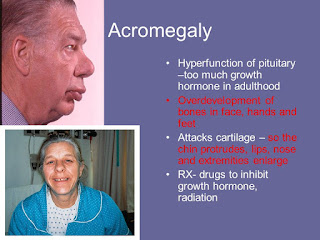
ACROMEGALY It is a disorder that results from excess growth hormone (GH) after the growth plates have closed (excess GH after puberty) It is a diseases of anterior pituitary Somatotrophs are abundant cells in pituitary somatotroph adenoma is most common cause of developing Acromegaly Mammosomatotroph adenoma growth hormone and prolactin increases clinical features : Galactorrhea Leading cause of extra pituitary source of excess growth hormone → pancreatic adenoma (islet cells tumor) Leading cause of excessive GHRH production → CARCINOID TUMOR CLINICAL FEATURES : ACRAL ENLARGEMENT : Increase in size of hand/feet Increase in finger thickness leading to spade like hands Lower Jaw prominence called as Prognathism Frontal Bossing Heel pad thickness >21 mm → used for monitoring growth in these patients Coarse facies / deep hollow voice ,Hyperhidrosis(excessive sweating) , sebum increase (increase incidence of acne) , ac...
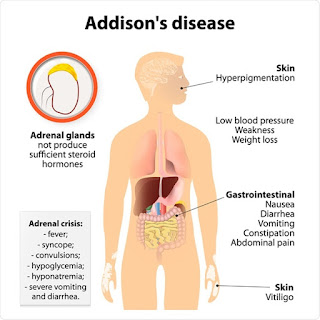
ADDISON'S DISEASE

Image
ADDISON'S DISEASE It is also known as PRIMARY ADRENAL INSUFFICIENCY / HYPOCORTISOLISM It is a long term endocrine disorder in which the adrenal glands do not produce enough steroid hormone(cortisol and aldosterone) Leading cause  → Autoimmune destruction most common cause in india → Tuberculosis of adrenals CLINICAL FEATURES : Aldosterone decrease resulting in : Salt wasting , craving for salty foods polyuria (urine output >3L/day) postural hypotension hyperkalemia metabolic acidosis Cortisol decrease resulting in : cortisol deficiency results in decreased blood sugar → palpitations,tremors,diaphoresis,RAGE attack,emotional fragility ACTH increased : Have partial melanocyte stimulating hormone like action resulting in Hyperpigmentation at palmar / sole creases scars / areola / axilla / cubital fossa groin area oral mucosa nails DHEAS (Dehydroepiandrosterone sulfate) decreased resulting in : decrease libido er...

HYPERALDOSTERONISM

Image
HYPERALDOSTERONISM It is a medical condition wherein too much aldosterone is produced by adrenal gland Hyperaldosteronism can be "primary" and "secondary" Primary hyperaldosteronism Excess production of aldosterone due to Bilateral adrenal hyperplasia (most common cause) Adrenal adenoma(tumor in the first layer of cortex)→ CONN'S SYNDROME   Features: increase aldosterone cause more stimulation of epithelium sodium channel (E NaC) resulting in Increase sodium and water absorption resulting in expansion of plasma volume contralateral urinary loss of potassium and hydrogen clinical features: Headache due to hypertension Urinary loss of potassium(hypokalemia) resulting in muscle cramps(weakness) metabolic alkalosis due to loss of hydrogen ions gain of water in the body → expansion of plasma volume which increase venous return → ANF release(atrial natriuretic factor)→ natriuresis(loss of water) so, gain of water = loss of water(...

RENAL ARTERY STENOSIS

Image
RENAL ARTERY STENOSIS Also known as Reno vascular hypertension It is the narrowing of one or both of the renal arteries ETIOLOGY: most common cause - Atherosclerosis fibromuscular dysplasia (FMD) - (young females) Takayasu arteritis  - Asian population (pulseless disease) CLINICAL FEATURE: Refractory hypertension sudden rise BP in preexisting HTN patient flash pulmonary edema presence of abdominal bruit (systole + diastole) check peripheral pulses poly arteritis nodosa - not cause of renal artery stenosis but can lead to Aneurysm formation WORKUP: USG - Asymmetric kidneys size - Not responding to anti hypertensive medication Doppler - best screening test CT Angiography Magnetic Resonant Angiography (MRA) - expensive ↓↓↓  - false positive results - due to turbulent flow - Gadolinium - cause nephrogenic system fibrosis IOC - Renal angiography (invasive test)(gold standard) DTPA scan before and after giving ACE inhibitor (Capt...

BERGER'S DISEASE

Image
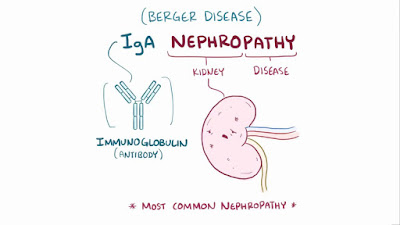
BERGER'S DISEASE It is also known as IgA Nephropathy first line of defence - IgA (Mucosal immunity) most common form of glomerulonephritis worldwide In berger's disease IgA increased with diffuse mesangial deposits - Capillaries - normal - golmerular filtration rate - normal - blood pressure - normal - microscopic Hematuria - If patient develops URTI (Upper respiratory tract infection) : IgA levels rise and over next 48 hours, microscopic hematuria is replaced by macroscopic / gross hematuria O/E - BP normal, no edema is noted WORKUP: >3RBC / HPF C3 normal in most cases TREATMENT: No consensus on optimal treatment

NEPHRITIC SYNDROME

Image
NEPHRITIC SYNDROME It is a syndrome comprising signs of nephritis, which is kidney disease involving inflammation. it often occurs in the glomerulus, which is called glomerulonephritis Vasculitis - GFR decreased and renin increased leading to - Hypertension - Hematuria - Sub nephrotic proteinuria POST STREPTOCOCCAL GLOMERULONEPHRITIS (PSGN) Type III Hypersensitivity reaction Immunological manifestation seen with nephritogenic stain - streptococcus Antigen - streptococcal pyrogenic exotoxin B (SPEP) Immune complex (+) - complement mediated vasculitis PSGN - begin as impetigo or pharyngitis Hematuria cola coloured urine - smoky urine(freshly voided sample) Hypertension - sudden onset - left ventricular failure Dyspnea - pulmonary edema Renal insufficiency leading to feature of uremia WORKUP: Urine microscopic - >3 RBC/HPF (high power field) - RBC casts - Dysmorphic RBC - always indicate glomerular bleeding C3 decreased, CH50...

MINIMAL CHANGE DISEASE

Image
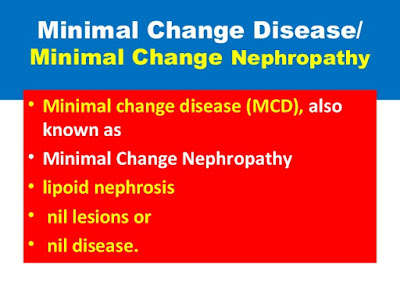
MINIMAL CHANGE DISEASE It is also "minimal change glomerulopathy" or nil disease It is a disease affecting the kidneys which causes a nephrotic syndrome                                 most common cause of nephrotic syndrome in children common age 2 - 8 yrs CLINICAL FEATURES: Puffy eyes vulval edema/scortal edema, pedal edema weight gain ++ Oncotic pressure decreased - albumin decreased - Selective proteinuria - pleural effusion bilateral(Transudative) - dyspnea - Ascites - Abdominal girth increased, everted umbilicus WORKUP: BUN/creatinine - normal urine microscopic - Oval fat bodies 24hrs urine protein increased urine protein electrophoresis C3 levels normal/decreased kidney biopsy - light microscopic - normal electron microscopic - podocytes - foot process effacement TREATMENT: Steroid - prednisolone 8weeks (Taper dose), good response and hence ca...

CONGENITAL NEPHROTIC SYNDROME

Image
CONGENITAL NEPHROTIC SYNDROME It is a rare kidney disease which manifests in infants during the first 3 months of life and it characterized by high level of proteins in urine - NPHS1 gene - Nephrin decreased zipper mechanism block defect - NPHS2 gene - Podocin decreased (bad prognosis) CLINICAL FEATURES: Non immune hydrops fetalis Anasara Foamy urine WORKUP: 24 hrs urinary protein = increased = >40mg/m2 BSA Serum albumin - decreased TREATMENT: Daily albumin infusion Steroids

MEMBRANOUS GLOMERULOPATHY

Image
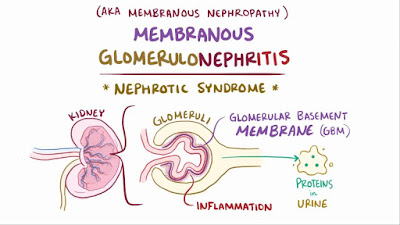
MEMBRANOUS GLOMERULOPATHY (MGN) Most common in Geriatric population primary membranous glomerulopathy: - Antibody against Phospholipase A2 receptor (PLA2)  Secondary membranous glomerulopathy: CONNECTIVE TISSUE DISORDER: RA/SLE/SCLERODERMA/MCTD AUTOIMMUNE DISORDERS LIKE HASHIMOTO THYROIDITIS/GRAVES INFECTION: ENTEROCOCCI ENDOCARDITIS/HBV/HCV/LEPROSY/MALARIA SOLID ORGAN TUMORS: LUNG CANCER DRUGS: PENICILLAMINE,CAPTOPRIL,MERCURY BASED COMPOUNDS CLINICAL FEATURES: Puffy eyes - pedal edema Anasarca Hypertension WORKUP: URINE - Oral fat bodies Blood urea nitrogen increased,serum creatinine increased Anti nuclear antibody (ANA) ++ HIV/HBV/HCV workup for malignancy(solid organ tumor) Cryoglobulin levels KIDNEY BIOPSY: - Hyper cellularity - polymorpho nuclear cells(PMN cells) - C3/ IgM/igG - Sub epithelial deposits + spikes Anti phospholipase A2 antibody +++ TREATMENT: Low protein diet Furosemide - oedema Hype...